


ART OF MAKING
Every detail of a helmet has its own function. Understanding its implementation makes the difference. In Brembate di Sopra, near Bergamo, Nolan has been producing helmets since 1972.

From here, over 400,000 helmets reach motorcyclists in more than 70 countries around the world. But what is most striking is not only the scale of the operation, but the way in which each phase integrates perfectly with the others.
Development, production, assembly and testing constitute a single continuous process: an approach now rare in our sector.

WHAT YOU DON'T SEE IS WHAT MATTERS MOST
Inside every helmet there is a material that you perhaps never think about: EPS (expanded polystyrene) is the material that plays the main role in absorbing impact energy.
By controlling how the material expands, Nolan creates EPS shells with different densities in specific zones, allowing you to tailor protection to your head's needs based on where and how it is needed most.
At Nolan, this process is developed internally. With up to six dedicated EPS shell sizes for each model, fit and protection are determined by construction.

TWO METHODS, ONE SINGLE APPROACH
At Nolan, the wraps are made in two different ways. Each approach serves a specific purpose, depending on the project and intended use.
 DISCOVER OUR LEXAN® RANGE
The polycarbonate granules are heated to around 300°C, transforming into a fluid material ready to be moulded.

Under high pressure, the material is injected into precision molds, shaping the shell structure through a controlled process.

The injection points and sharp edges resulting from the molding process are carefully smoothed and finished to obtain a perfect surface.


Fiber layers — such as those made of glass, carbon or aramid — are cut and prepared to fit the shell design.

Each layer is placed in the mold by hand, building the structure step by step with precision and care.

The shell is hardened using heat and pressure, allowing the materials to bond together and reach their final strength.


 DISCOVER OUR X SERIES CARBON RANGE
Openings and details are precisely cut using high-pressure water jets.

The shell is machine finished and carefully sanded, giving the surface a precise and uniform finish.
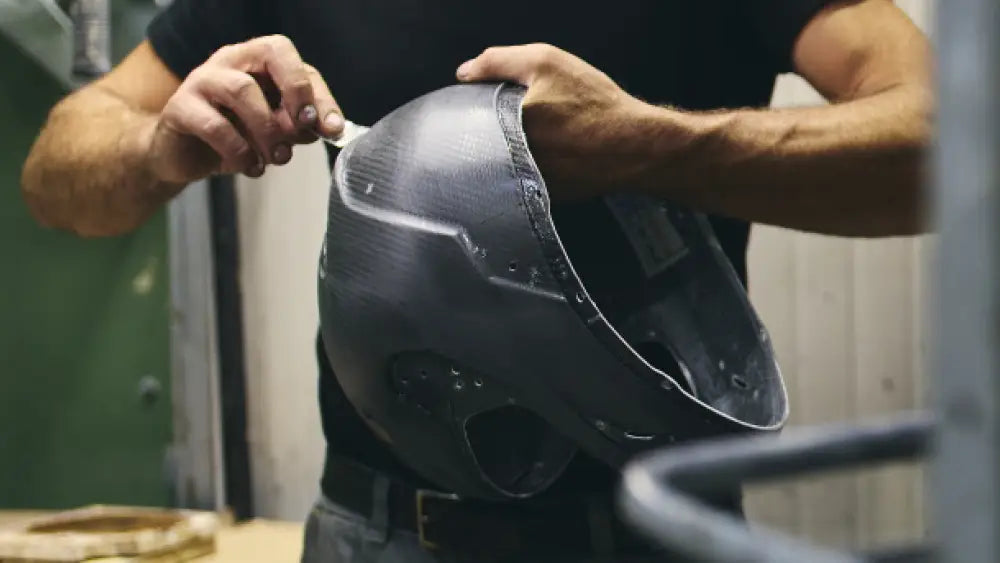
The finishing touches are done by hand: sanding, adjusting and preparing the shell for finishing.


